

TTS VOICE DIRECTION BENCHMARK
How well can TTS models take direction?
An open benchmark measuring how reliably TTS models follow natural-language performance instructions while preserving speaker identity from zero-shot reference audio.
LEADERBOARD
Voice Direction Leaderboard
Voice Direction Score (VDS)
 Breeze TTS 2
 MiMo-v2.5-TTS
 StepAudio 2.5 TTS
 Qwen-Audio 3.0-TTS-Plus
 Inworld TTS-2
 VoxCPM2
METRICS
Two measures of effective voice direction
We evaluate direction following and speaker preservation. Together, they capture how well a model changes the performance and how reliably it maintains the original voice.

Voice Direction Score
Measures how successfully the generated speech fulfills the natural-language direction. It uses a holistic five-point scale, considering fulfillment of explicit requirements, requested intensity, timing and transitions, preservation of the intended meaning, and the coherence and practical usability of the performance.

Speaker Similarity
Measures how well the generated audio preserves the reference speaker. We extract speaker embeddings and compute cosine similarity between each generated sample and its reference audio. Higher values indicate stronger preservation of the original voice.
DATASET
700 cases. 9 axes. 25 voices.
Evaluate how well TTS models follow natural-language direction across 9 axes of steerability and 25 distinct reference voices. The benchmark tests whether voice control generalizes across different speakers, instructions, and scenarios.
Capability Groups
Foundational Speech Control
Direct control of audible speech features
Situational Voice Acting
Delivery shaped by emotion, state, intent, and role
Complex Instruction
Combining multiple controls and changing delivery over time
LISTEN TO THE GAP
Which system follows the voice direction better?
Voice Direction
A voice choking up, fighting against a tightening throat.
Preset Voice
Script
It's just hard to say goodbye to this old house after living here for forty years and seeing everything change around us.
Voice A
Voice B
RESOURCES
Reproduce the results, or try voice direction
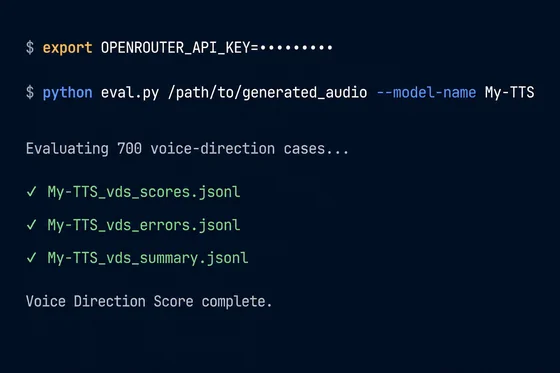
Evaluation Suite
Everything needed to reproduce these results or evaluate a new system.
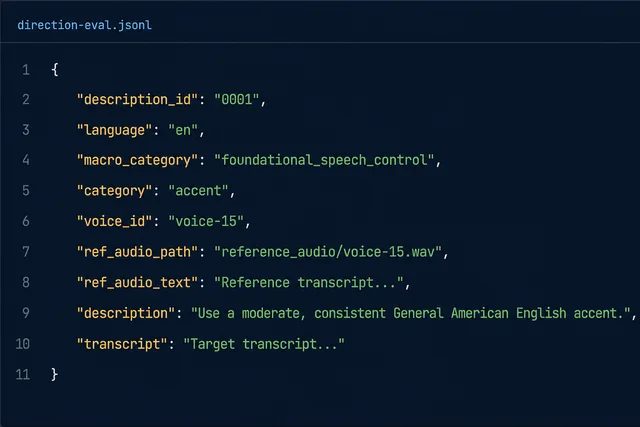
Get the dataset
All 700 English voice-direction tasks across 25 reference voices, with natural-language instructions.
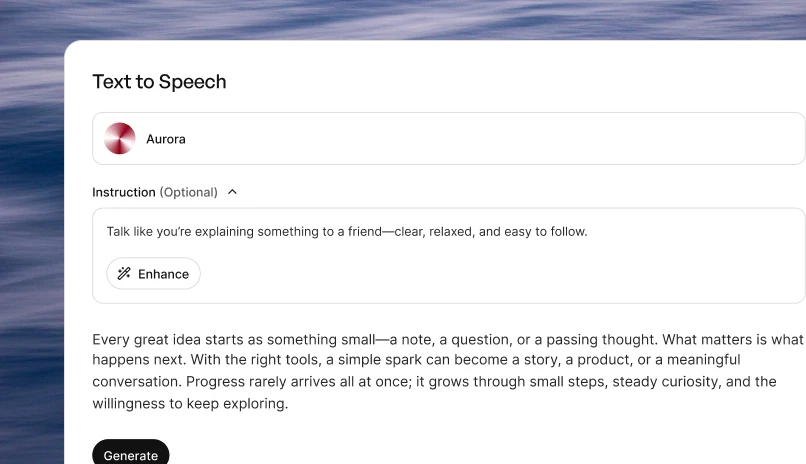
Direct every performance
Shape tone, emotion, pacing, and delivery with natural-language instructions in BreezeBlue Studio.