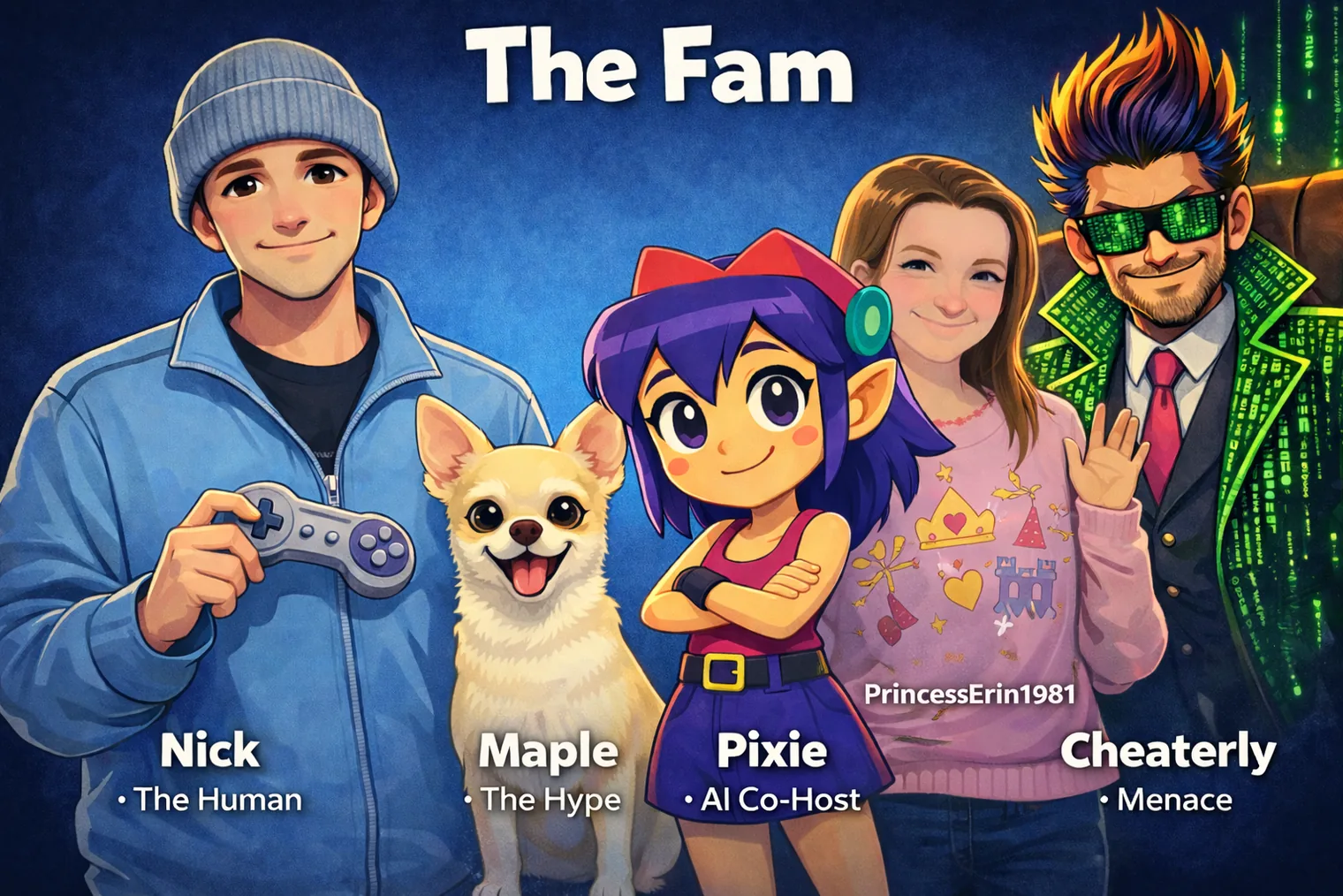
Nick Kilcoyne is a Twitch streamer based in Portland, Oregon, known online as 90sNickTV. He also shares content on YouTube. His streams have a nostalgic 1990s feel, and his AI co-host, Pixie, began with a practical need while gaming.
When Nick gets stuck in a game during a Twitch stream, stopping to search for a walkthrough is not an ideal solution. It interrupts the pace of the stream and pulls attention away from the audience.
Nick imagined something more entertaining: what if he could ask a question out loud and get an answer from an AI character without interrupting the flow of the stream?
That idea became Pixie, an AI co-host who can speak with Nick, react to what is happening in a game, and interact with people watching the stream. What started as a practical way to get help has grown over roughly three years into a character with her own presence, personality, and performance style.
A question that became a co-host
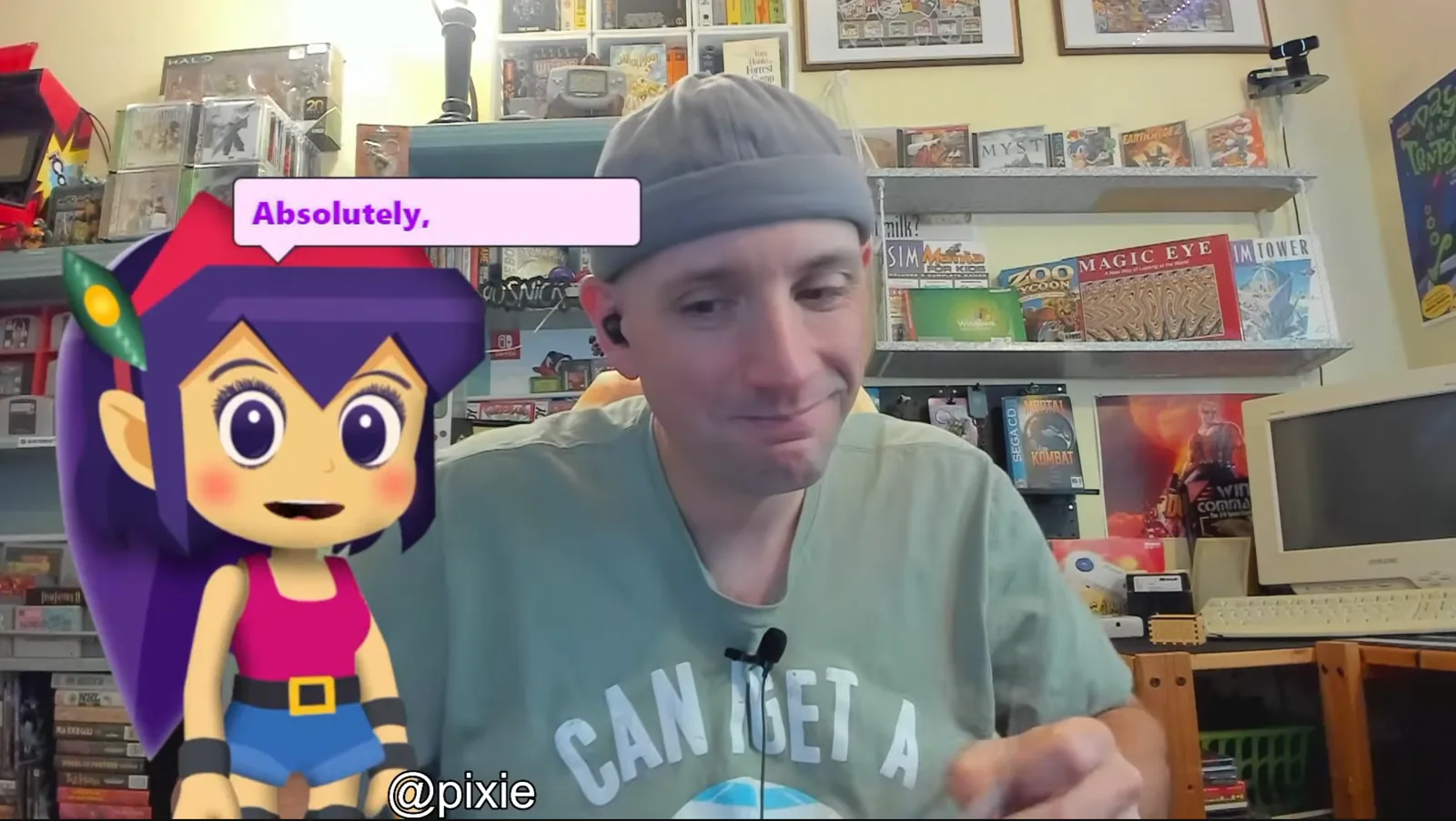
Nick often streams older games he has never played before. Getting stuck is part of the experience, but looking up the answer can bring the stream to a halt. He wanted to preserve the spontaneity of discovering a game while making the moment more engaging for viewers.
When creating Pixie, Nick drew inspiration from the friendly fictional AI and robot characters he grew up with, including Johnny 5 from Short Circuit, C-3PO from Star Wars, and Robot from Lost in Space.
The earliest version of the idea was simple. Nick would ask a question through ChatGPT and play the response through a voice. Over time, he built a more complete system around the interaction and gave the assistant a character identity. Pixie gradually moved beyond answering game questions. She began responding to Nick as a co-host and participating in conversations with Twitch viewers.

Pixie v1

Pixie v2

Pixie v3
Nick hand-animates Pixie himself, and her look has changed over time as she's grown from a game assistant into his on-stream co-host.
That shift changed the role of the voice. It was no longer enough for the system to read an answer accurately. Pixie needed to sound like a character who belonged in a live show.
Finding a voice that could keep up
Live interaction places a hard limit on how long a response can take. A voice can sound excellent, but if it arrives after the conversation has moved on, it is no longer useful.
Nick tested a range of cloud-based and local text-to-speech systems while developing Pixie. Some responded quickly but delivered each line in a similar, predictable way. Others offered more emotional range but introduced enough delay to create an awkward pause. He often found himself choosing between speed, sound quality, and expression.
Nick discovered BreezeBlue while looking for a voice solution for Pixie.
For Nick, two capabilities needed to work together. Pixie had to begin speaking quickly enough to preserve the rhythm of a live conversation, and she had to follow natural language instructions in a way that made her performance feel varied and alive.
“Those two things together are the main reasons I decided BreezeBlue was the right choice.”
A voice that performs, not just reads
Pixie is not designed to sound like a neutral narrator or a customer service assistant. She may need to be playful in one moment, dramatic in the next, or shift her delivery within a single response.
Nick uses natural language instructions to guide how each line should be performed. The instructions can describe emotion, pacing, accent, or another aspect of the delivery. Because they are written in everyday language rather than selected from a fixed set of emotion labels, they can change with the context of each conversation.
Nick's system can generate these instructions dynamically. The language model considers what is happening in the conversation and produces natural language instructions for how Pixie should say the next response. BreezeBlue then turns the text and those instructions into speech.
Pixie refines her André the Giant impression in real time by adding a French accent.
An impression, refined in real time
One of Nick's favorite examples began when he asked Pixie to imitate André the Giant, the French wrestler and actor known for his distinctive deep voice. Pixie first responded in a very deep voice. When Nick reminded her that André also had a French accent, she combined the deep character voice with the accent in her next response.
“Pixie needs to be expressive. She needs to have emotions, and she needs to be able to do accents.”
Nick did not need to choose a voice preset, adjust sliders, or manually create a new character voice. The same language model that generated Pixie's response also produced natural language instructions for how it should be performed, which BreezeBlue interpreted dynamically. This allows Pixie to improvise voices during a live conversation.
Within the same piece of audio, Pixie can whisper, laugh, change emotion, or adjust her pace as the moment calls for it.
Nick cannot predict what viewers will ask Pixie to do, or how the language model will describe the voice performance each request calls for. In his experience, BreezeBlue handles these varied natural language instructions well, without requiring them to follow a rigid format. That flexibility lets Pixie respond to requests and situations he could not realistically anticipate or program for in advance.
Making every response feel immediate
Nick also designed his application to reduce the time before Pixie begins to speak. Instead of sending an entire response as one long text-to-speech request, the system divides it into three parts:
01
Short preamble
A few words
02
First sentence
One complete sentence
03
Remaining response
The rest of the answer
The first portions can begin playing while the rest of the response is still being prepared. This makes the exchange feel more immediate, even when Pixie has a longer answer to deliver.
Nick estimates that Breeze TTS 2 usually begins returning audio in approximately 300 milliseconds in his setup. He describes it as the fastest voice system he has used.
The application also includes safeguards for a live environment. If a response arrives too late and the conversation has already changed, the system can skip it rather than interrupt the current moment with an outdated answer.
This is what makes real-time voice different from producing an audio file. Success is not only about whether the audio is eventually generated. It is about whether the voice arrives while the response still belongs in the conversation.
Giving the audience another character to talk to
Pixie now interacts with both Nick and the people watching his Twitch streams. Viewers do not only listen to her. They can become part of the exchange, making the AI co-host another participant in the show rather than a voice playing in the background.
Viewers have always enjoyed testing the limits of what Pixie can do by asking her to speak in different voices, accents, and styles. BreezeBlue brought one capability no earlier system had handled convincingly: singing. Once viewers discovered that Pixie could change how she used her voice and actually sing, it quickly became a regular request.
At a viewer's request, Pixie shifts into a dramatic voice to tell a horror story.
When a viewer asks Pixie to sing, she changes her delivery on the spot.
For Nick, this audience participation also means the system needs to remain flexible. A planned narration can be generated in advance, but a viewer's message cannot. Pixie's response has to be created in the moment, delivered quickly, and performed in a way that feels consistent with her character.
That combination has turned voice generation into part of the live format itself. Pixie is not simply reading content Nick has already written. She helps create moments that would not exist without the interaction between the streamer, the audience, and the character.
What comes next for Pixie
Pixie has already grown far beyond the original idea of a voiced game assistant. Next, Nick wants to synchronize her speech, on-screen text, and animation even more precisely, making the character feel increasingly present during live interactions.
With BreezeBlue, Nick has the speed and expressive control needed to make Pixie feel present in a live conversation. Fast voice generation keeps each exchange moving, while precise direction helps preserve the personality behind every response. BreezeBlue gives Nick the voice foundation he needs to keep developing Pixie as a character who can truly take part in the show.