
At BreezeBlue, we are rethinking what the future of audio intelligence should sound like.
Previous voice technologies excel at copying. But the next generation of Voice AI should do more: it should understand nuance, adapt across contexts, and remain controllable.
Breeze TTS is our first step in that direction — a generative speech model that brings state-of-the-art instruction following to speech generation.
01
Motivation
Speech generation has been optimized for realism. We believe it now needs to be optimized for intent.
The field has made enormous progress in naturalness, speaker consistency, and voice cloning. But high-fidelity reproduction is not the same as controllable generation. A voice that sounds perfect is not always a voice that feels right, fits the context, or follows direction.
Other generative domains have already moved in this direction. In language and visual generation, instruction following is now a core capability. Users expect models to respond to prompts with precision, flexibility, and range. Speech generation should be no different.
With Breeze TTS, we treat instruction following as a first-class capability for speech. The goal is not just to generate natural audio, but to generate speech that can be shaped by creative intent: a voice defined by persona, a performance shaped by context, and a delivery that changes with the scene.
02
Breeze TTS — A New Kind of Speech Model
At its core, Breeze TTS is an audio language model built on top of a pre-trained large language model. It is further trained on interleaved text-and-audio sequences, allowing text and audio to be modeled in a single stream. In this formulation, text provides instructions and script, while audio serves both as a conditioning signal and as a generation target.
This gives Breeze TTS strong instruction following ability in two settings: creating a new voice from text alone, and directing how an existing voice performs from a speech reference.
2.1
To Design: Create a new voice from a text prompt
Breeze TTS combines world knowledge with a strong understanding of natural language. It can follow open-ended text prompts — whether they describe the persona, tone, scenario, or style — and generate a voice that matches the intended character.
Instructions
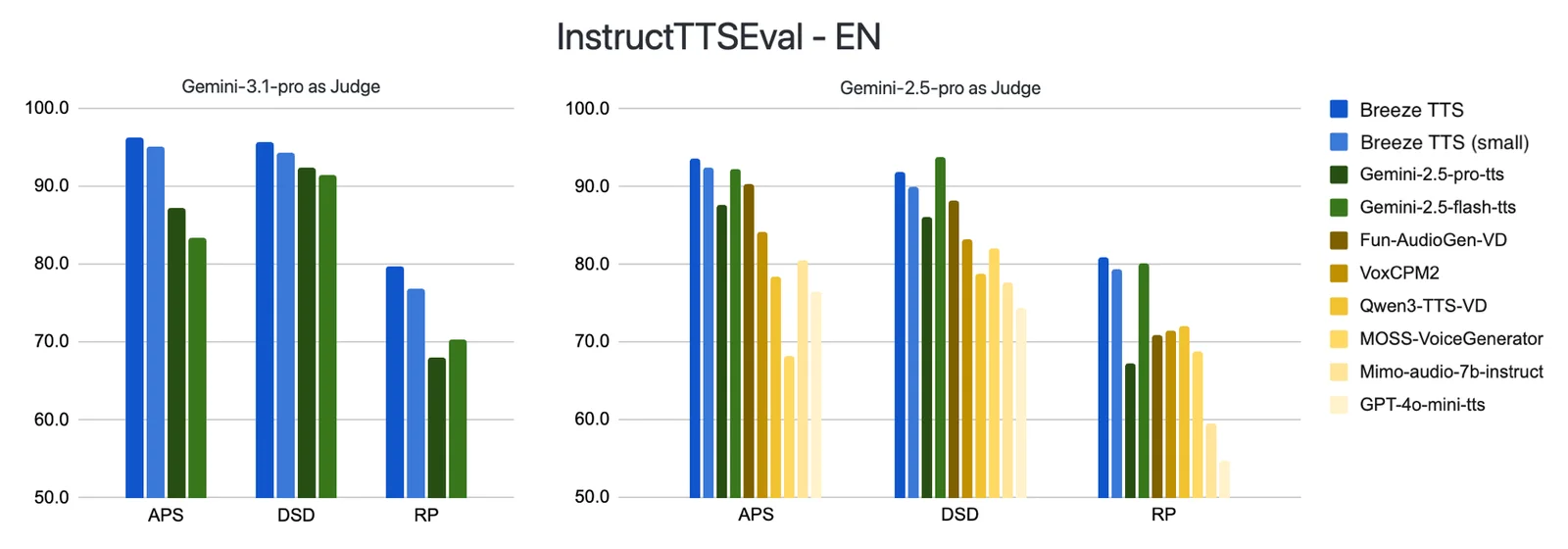
We evaluate Breeze TTS on InstructTTSEval, a benchmark for measuring complex natural-language style control in speech generation. InstructTTSEval covers three types of instructions styles: Acoustic-Parameter Specification (APS), Descriptive-Style Directive (DSD), and Role-Play (RP), each with 1K test cases. Breeze TTS achieves state-of-the-art results on this benchmark, demonstrating strong ability to understand complex instructions and generate diverse voices. Unless otherwise stated, Gemini-3.1-pro is used as the evaluation judge. Based on our internal human evaluation, it provides more unbiased scoring than Gemini-2.5-pro.
2.2
To Direct: Instruct an existing voice to perform in a new speaking style
Voice direction emerges naturally from training on long-horizon audio data. Breeze TTS can follow natural-language instructions to alter the speaking style of a reference speech clip, while preserving the underlying speaker identity. Importantly, guidance strength can be adjusted to trade off between speaker consistency and instruction following.
Reference Voice
Instructions
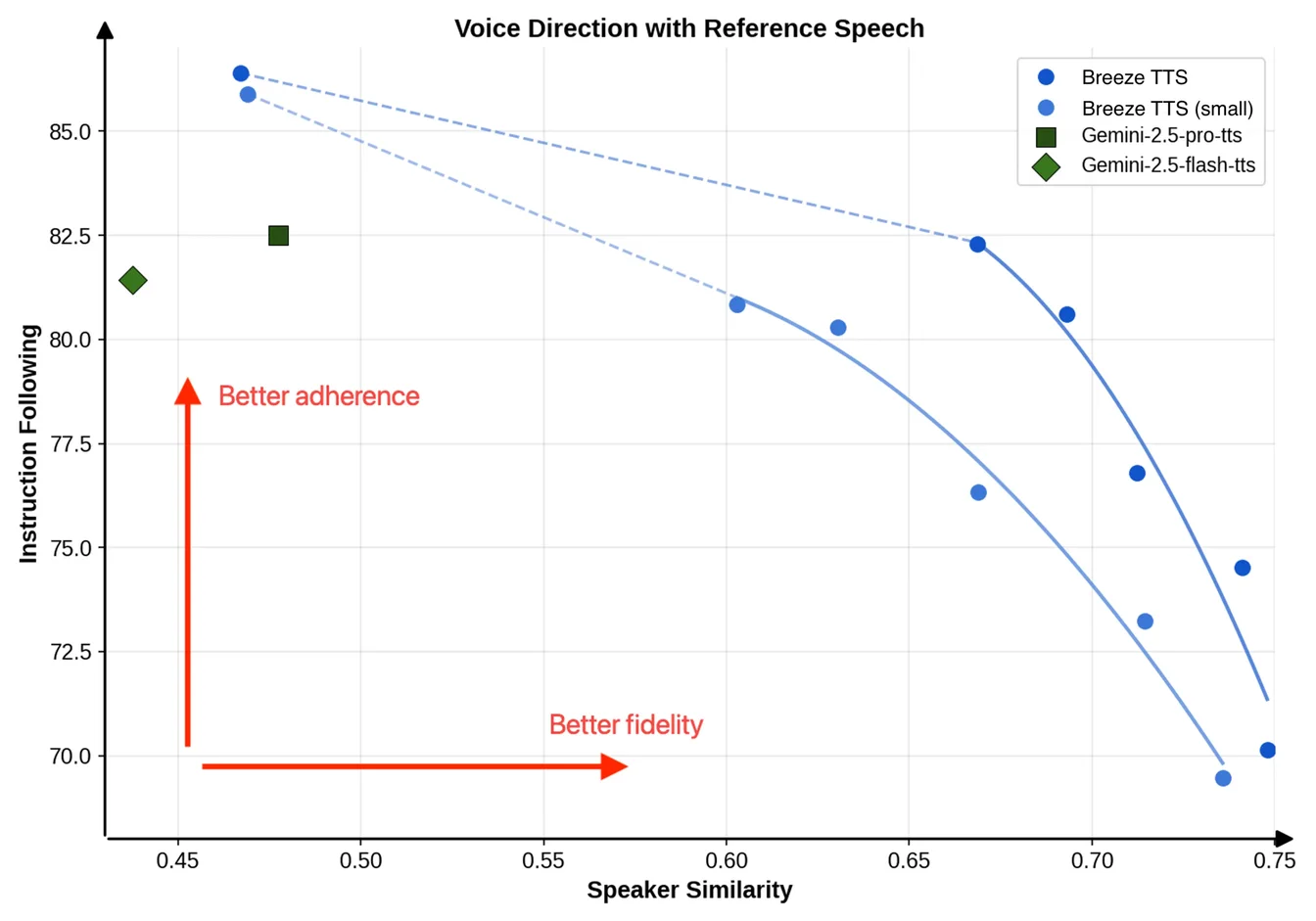
We evaluate this setting on InstructTTSEval. For each of the 3K test cases, we randomly select one of the 30 preset Gemini TTS voices as the one-shot reference for Breeze TTS. We vary the guidance strength at test time to measure the trade-off between instruction following and speaker consistency. Breeze TTS achieves a state-of-the-art Pareto frontier in voice direction, with a clear scaling trend: at the same level of instruction following, larger models preserve speaker consistency better.
03
Try Breeze TTS
Speech generation is moving beyond reproduction toward creation, direction, and interaction. With Breeze TTS, we are taking an early step toward speech models that can follow intent, adapt to context, and unlock a wider range of voice experiences.
This is just the beginning. Our mission is to create the next generation of audio-native experiences through research and products. We're excited to share Breeze TTS with creators, developers, and teams exploring what those experiences could become.