
Breeze TTS 2 is now the #1 open-weights text-to-speech model on the Artificial Analysis Provider Voice Arena leaderboard, with a Quality Elo score of 1215.
In the August 26, 2026 leaderboard snapshot, Breeze TTS 2 led every other open-weights TTS model evaluated by Artificial Analysis. It finished 90 Elo points ahead of second-place Fish Audio S2 Pro and 113 points ahead of third-place Step Audio EditX.
This is an important milestone for BreezeBlue and for open-weights voice AI. The ranking is based on blind human listening preferences, not vendor-selected scores or automated audio metrics, and establishes Breeze TTS 2 as the highest-rated open-weights model in this independent TTS evaluation.
What is the Artificial Analysis TTS Arena?
The Artificial Analysis Text to Speech Arena is an independent benchmark that compares speech-generation models through blind, head-to-head listening tests.
In each comparison, listeners hear two audio clips generated from the same text without seeing which models produced them. They select the clip that sounds more natural, and Artificial Analysis aggregates those preferences into a relative Quality Elo score. A higher Elo score means listeners preferred that model more often compared with the other models in the Arena.
The leaderboard is designed to capture perceived speech quality as experienced by real listeners. That includes qualities such as:
Naturalness
Audio quality
Pronunciation
Pacing
Prosody and expressiveness
For the Provider Voice Arena, Artificial Analysis evaluates each model using a representative set of its available voices. It aims to cover male and female voices across US and UK accents, with up to eight voices per model. The resulting score therefore reflects the overall experience of using the voices associated with each model, rather than a single hand-picked demo.
Artificial Analysis also publishes sample counts, confidence ranges, category filters, and accent filters to help readers interpret the ranking. Elo is a relative measure, so scores can change as new votes are collected and new models enter the Arena.
Breeze TTS 2 leads the open-weights leaderboard

The top five open-weights models in the Provider Voice Arena were:
| Rank | Model | Creator | Quality Elo |
|---|---|---|---|
| 1 | Breeze TTS 2 | BreezeBlue | 1215 |
| 2 | Fish Audio S2 Pro | Fish Audio | 1125 |
| 3 | Step Audio EditX (March 2026) | StepFun | 1102 |
| 4 | Voxtral TTS | Mistral | 1082 |
| 5 | Magpie-Multilingual 357M | NVIDIA | 1066 |
Breeze TTS 2 held a 90-point lead over its nearest open-weights competitor. In an Elo-based system, every score is determined relative to listener preferences across the model pool, making that lead a meaningful signal of how consistently listeners chose Breeze TTS 2.
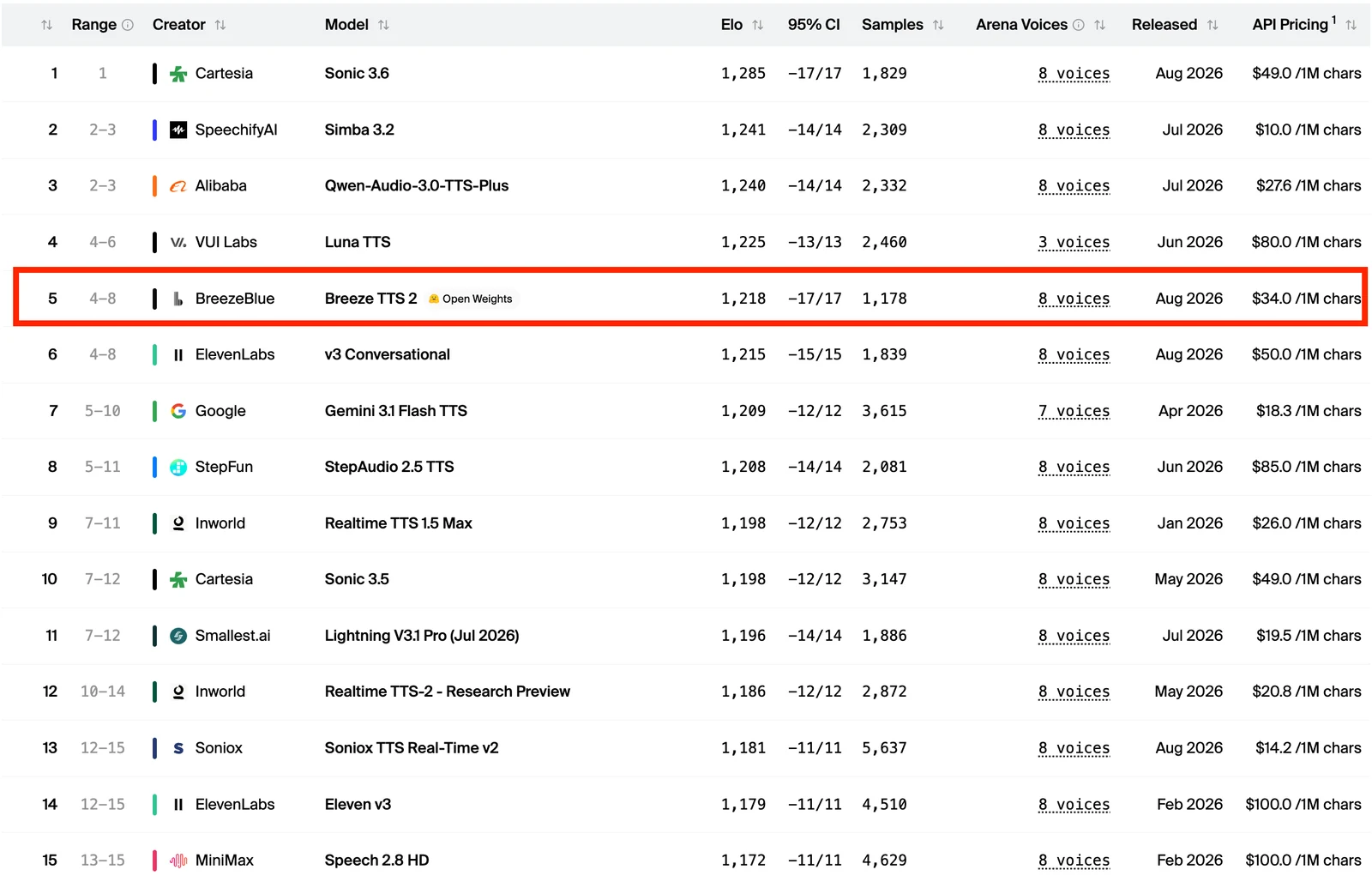
The full Provider Voice Arena also places Breeze TTS 2 among the highest-rated TTS systems overall, alongside leading proprietary models. Because Arena scores update continuously as new votes arrive, the full-leaderboard image below reflects a later snapshot.
Why this No. 1 ranking matters
We believe developers should not have to choose between access and exceptional voice quality. Open-weights speech models offer greater flexibility to inspect, evaluate, and run a model within a team's own infrastructure, but they have historically trailed the strongest commercial APIs in perceived quality.
The Artificial Analysis result shows a different picture. In blind comparisons, listeners placed Breeze TTS 2 clearly ahead of the rest of the open-weights field and in the same top tier as leading proprietary TTS systems.
This makes the ranking relevant for teams building:
Conversational voice agents
Game and animation characters
Audiobooks and narrative content
AI dubbing and localization workflows
Podcasts and creator tools
Customer-service applications
For these products, speech must do more than pronounce words correctly. It needs to sound natural, carry intent, maintain a convincing voice identity, and fit the context of the interaction. Human preference testing is valuable because listeners judge those qualities together rather than reducing them to one automated signal.
Built to design a voice and direct its performance
We built Breeze TTS 2 to give every character the right voice and every line the right performance. It combines high-rated speech quality with controls for creating and directing voices:
[Voice Design](/voice-design) creates a distinctive voice from a natural-language description, without requiring reference audio.
[Voice Clone](/voice-cloning) uses reference audio and its transcript to preserve a speaker's timbre, rhythm, emotion, and style.
Voice Direction uses natural-language instructions to steer tone, emotion, pace, and delivery while keeping the reference voice recognizable.
Vocal Events add expressive moments such as laughter, sighs, coughs, and throat clearing directly in the script.
Real-Time Streaming supports streaming audio generation, with time to first audio (TTFA) under 40 ms.
English and Chinese generation is supported in the open-weights release.
These capabilities make Breeze TTS 2 more than a collection of preset voices. Developers and creators can design a character, preserve its identity, and direct how it performs a particular line, all within the same model.
The Arena result adds an important external signal to that capability set: when listeners compared the generated speech without knowing the model name, Breeze TTS 2 emerged as their top open-weights choice.
A new benchmark for open-weights voice AI
No public leaderboard can represent every script, speaker, language, or production environment. But blind human preference provides one of the clearest tests of the experience that matters most: how the generated voice actually sounds to a listener.
The result provides a strong starting point. Breeze TTS 2 achieved:
The No. 1 position among open-weights TTS models
A Quality Elo score of 1215
A 90-point lead over the second-ranked open-weights model
For us, this result validates a core idea behind Breeze TTS 2: an open-weights model can deliver natural, expressive speech while giving developers deeper control over voice creation, performance, and deployment.
Breeze TTS 2 is available through BreezeBlue Creator and the BreezeBlue API. Developers can also access the Breeze TTS 2 model weights on Hugging Face and the official PyTorch inference code on GitHub.